
You've Taken a Career Test — What's Next?
Turn Your Career Test Results Into a
Career Action Plan!
Congratulations! You've taken an important step toward discovering your future career.
But completing a career test is just the beginning!
Now that you have your career assessment results, what should you do next?
Your results provide valuable insights into your interests, personality, strengths, abilities, and potential career opportunities. However, the real value comes from using those insights to make informed career decisions.
Whether you're a high school student exploring future careers, a college student selecting a major, an adult considering a career change, or a job seeker looking for new opportunities, having a clear career plan can help you move forward with confidence.
At CareerPlans4All.com , we provide career exploration tools and resources to help you turn your assessment results into achievable career goals .
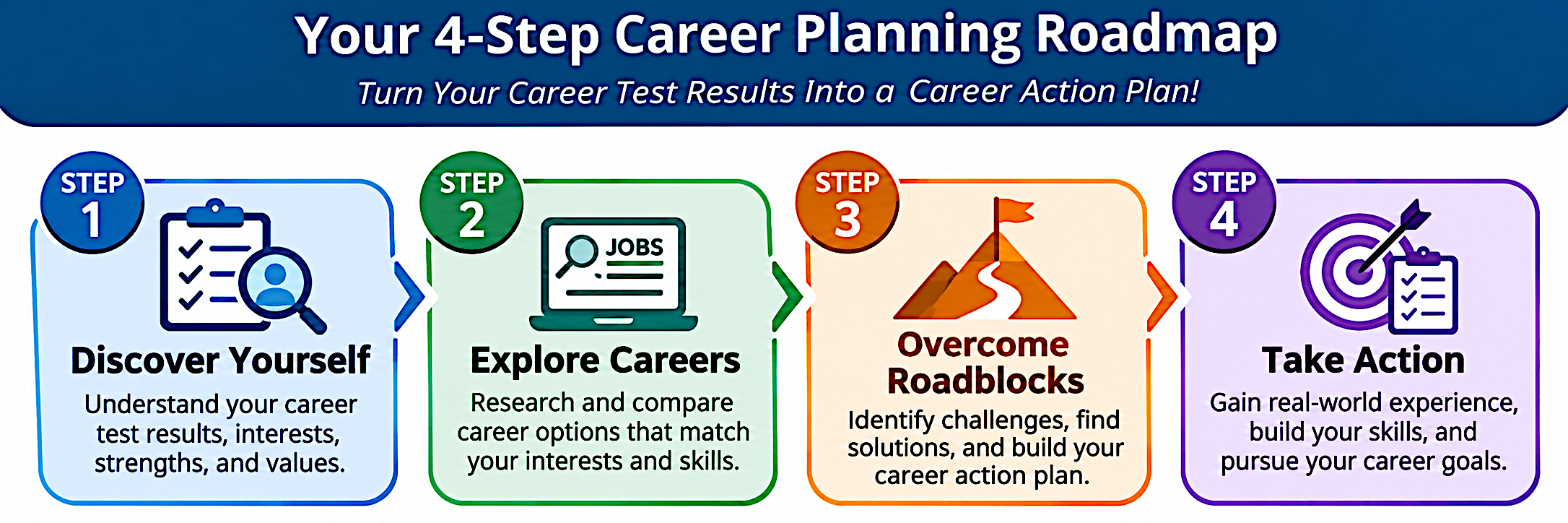
Your 4-Step Career Planning Roadmap
STEP 1: Discover Yourself — Understand Your Career Test Results
Your career assessment results are the starting point for your career journey!
Before making career decisions, take time to understand what your assessment reveals about you.
Your results may help you identify:
- Career Interests: What activities, subjects, and work environments do you enjoy?
- Personality Preferences: How do you prefer to communicate, learn, work, and make decisions?
- Strengths and Abilities: What are your natural talents and developed abilities?
- Transferable Skills: What skills can you use in different careers and industries?
- Work Values: What matters most to you in a career?
- Career Preferences: What salary, work schedule, location, and working conditions do you prefer?
Understanding Your Holland Codes (RIASEC)
If you completed a Holland Codes or RIASEC career assessment, review your results using the six career interest types:
Realistic (R)
Practical, hands-on activities, tools, and technology.
Investigative (I)
Research, analysis, science, and problem-solving.
Artistic (A)
Creativity, imagination, design, and self-expression.
Enterprising (E)
Leadership, persuasion, entrepreneurship, and business.
Conventional (C)
Organization, data management, accuracy, and structured activities.
Your highest interest areas can help you identify careers and work environments worth exploring.
Remember, career assessments provide guidance and possibilities—not limitations on what you can achieve.
STEP 2: Explore Career Opportunities — Find Careers That Match Your Interests
Now that you understand yourself better, it's time to explore your career possibilities!
Use your assessment results to develop a list of potential occupations that match your interests, skills, personality preferences, and values.
Research Your Career Options
For each occupation, investigate:
- Career Description: What does a person in this occupation do?
- Job Responsibilities: What are the typical daily tasks?
- Education and Training: What degrees, certifications, apprenticeships, or licenses are required?
- Skills and Abilities: What qualifications do employers expect?
- Salary and Benefits: What are the typical earnings and compensation opportunities?
- Employment Outlook: Is demand for this occupation growing, stable, or declining?
- Work Environment: Where and under what conditions do people work?
- Career Advancement: What opportunities exist for professional growth?
Explore Different Career Pathways
Your future career may involve:
Helpful Career Exploration Resources
Use these trusted resources to investigate occupations, educational requirements, and employment opportunities:
- O*NET OnLine — Research occupations, skills, work activities, and career interests.
- Occupational Outlook Handbook — Explore salaries, education requirements, and employment projections.
- CareerOneStop — Find career exploration, training, and job search resources.
- Apprenticeship.gov — Discover registered apprenticeship opportunities.
STEP 3: Overcome Career Roadblocks — Build Your Career Action Plan
Every career journey has challenges. The key is learning how to overcome them!
You may encounter obstacles such as uncertainty about your career choice, limited financial resources, educational requirements, lack of experience, or changing employment opportunities.
These challenges do not have to prevent you from reaching your goals.
Identify Your Career Roadblocks
Ask yourself:
- Do I need additional education or training?
- Can I afford the required educational program?
- Do I have the skills and experience employers are seeking?
- Are career opportunities available in my geographic area?
- Do I need help developing a resume or preparing for interviews?
- Do I have access to career mentors, counselors, or professional networks?
Develop Solutions and Strategies
Use the following problem-solving process:
- Identify the obstacle. Clearly define what is preventing you from reaching your career goal.
- Explore possible solutions. Research alternative educational, financial, and employment opportunities.
- Set achievable goals. Break larger career goals into smaller, manageable steps.
- Create an action plan. Identify the activities, resources, and timelines needed to move forward.
- Evaluate your progress. Review your results and make adjustments when necessary.
Make Informed Career Decisions
Before selecting a career pathway, consider:
- Your career interests, strengths, abilities, and work values
- Education and training requirements
- Tuition, fees, and other educational expenses
- Financial aid, scholarships, and apprenticeship opportunities
- Employment availability and earning potential
- Personal responsibilities and lifestyle preferences
- Alternative career options
STEP 4: Take Action — Turn Your Career Plan Into Reality!
You've discovered your interests, explored career options, and developed a plan. Now it's time to take action!
Career planning becomes meaningful when you connect your goals with real-world experiences and opportunities.
Reality Testing: Experience Careers Before Making a Commitment
Reality testing helps you determine whether a career matches your expectations, interests, abilities, and lifestyle.
Consider these opportunities:
Informational Interviews
Talk with professionals about their careers, responsibilities, and experiences.
Job Shadowing
Observe professionals in their work environments.
Internships
Gain practical experience in an occupation or industry.
Volunteer Opportunities
Develop skills while exploring potential career interests.
Part-Time Employment
Gain work experience and evaluate your career preferences.
Apprenticeships
Combine paid employment with structured occupational training.
Professional Networking
Build relationships with employers, mentors, and industry professionals.
Prepare for Your Next Career Opportunity
Depending on your career goals, your next steps may include:
- Applying to college, trade school, or a training program
- Researching scholarships and financial assistance
- Completing professional certifications
- Developing a resume and cover letter
- Building a professional LinkedIn profile
- Practicing job interviewing skills
- Searching for internships or employment opportunities
- Meeting with a career counselor or mentor
Your Career Planning Action Checklist
Use this checklist to turn your career assessment results into an actionable plan.
0 of 13 activities completed (0%)
STEP 1: Discover Yourself
STEP 2: Explore Careers
STEP 3: Overcome Roadblocks
STEP 4: Take Action
Your Career Test Is the Beginning — Not the End!
Your career assessment results are more than a list of occupations. They are tools to help you understand yourself, discover possibilities, and make informed decisions about your future.
The Four Steps to Career Success Are:
1. Discover Yourself
Understand your interests, personality, skills, and values.
2. Explore Careers
Research occupations and educational pathways that match your interests.
3. Overcome Roadblocks
Identify challenges and create a realistic career action plan.
4. Take Action
Gain experience, develop skills, and pursue your career goals.
Ready to Take the Next Step in Your Career Journey?
Don't stop at your career test results. Discover what comes next!
CareerPlans4All offers career assessments, exploration resources, and educational tools to support your career planning journey.
Whether you're exploring your first career, selecting a college major, returning to the workforce, or planning a career transition, we're here to help you explore your possibilities.