

Learn about our High School Career Tests!
Right High School
Career Test Table
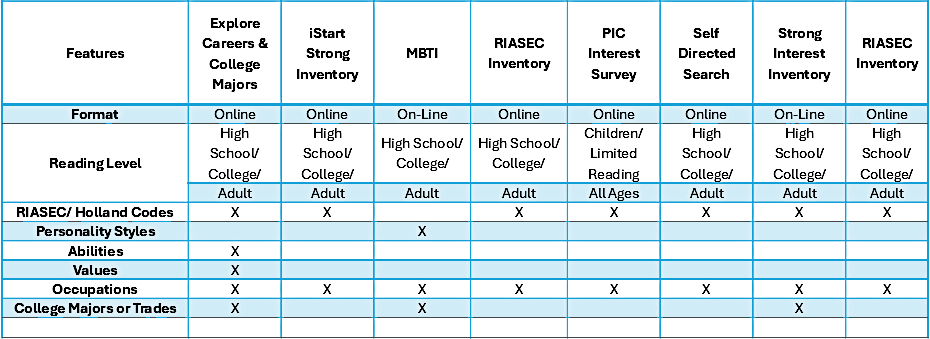

Get the most reputable online career test platforms for high school students!
OVERVEW OF CAREER TESTS

High school student, are you looking for tools to gain awareness of your interests as well as careers, college majors, and trades? Building career awareness is the first fundamental step in the career planning process to help you unlock your potentials. Finding the correct career tool is a fundamental step to identifying and achieving their career goals. You need a right tool to identify the connection between interests, careers, and college majors.
Examples of high school research-backed career tests are:
RIASEC Inventory Test
Career Test Features
Here are features of some research-backed, commonly used high school career tests -
RIASEC Inventory
Format: On-Line NEW!
Reading Level: High school student
Subject Area: Holland Codes, Interests, Occupations
Strong Interest Inventory®
Format: On-Line
Reading Level: High school student
Subject Area: Holland Codes, Interests, Occupations
Built on decades of research and grounded in the well-established RIASEC model, the Strong Interest Inventory® is regularly updated to ensure its validity, reliability, and relevance in the ever-evolving world of work.
Format: On-Line
Reading Level: High school student
Subject Area: Holland Codes, Interests, Occupations
Myers-Briggs Type Indicator® (MBTI®)
Format: On-Line
Reading Level: High school student
Subject Area: MBTI/ Personality Types, Occupations (Source: themyersbriggs.com)
Self Directed Search used by more than 23 million people throughout the world to help find occupations that suit their interests and skills and to make successful career decisions.
Format: On-Line
Reading Level: High school student
Subject Area: Holland Codes, Interests, Occupations
Myers-Briggs Type Indicator® (MBTI®)
The Myers-Briggs Type Indicator® (MBTI®) assessment is the most widely used personality assessment in the world – more than 2 million assessments worldwide each year.
Reliable, valid, versatile, and dependable - Used for more than 50 years
The Myers-Briggs Type Indicator® (MBTI®) types are in four groups –
Extraversion / Introversion
Sensing / Intuition
Thinking / Feeling
Judging / Perceiving
The results from the MBTI® produces the 16 types –
ISTJ
ISFJ
INFJ
INTJ
ISTP
ISFP
INFP
INTP
ESTP
ESFP
ENFP
ENTP
ESTJ
ESFJ
ENFJ
ENTJ
Myers-Briggs Type Indicator® (MBTI®) Career Report
The MBTI® Career Report is a career exploration tool that helps you –
Identify strengths and weakness that may influence the career exploration process
Identify job families
Choose a potential career
Select form of training
Develop a career plan
The MBTI® Career Report has information on –
MBTI® Results – Reported Type and Clarity of Reported Preferences
MBTI® Types and Career Choice – preferred work environments, and action steps
MBTI® Types and Career Exploration – Strengths, challenges, strategies, and action steps
MBTI® Types and Career Development – Strengths, challenges, strategies, and action steps
MBTI® Types and Job Families – Job family ranking, Most attractive job families, Moderately attractive job families, Least attractive job families, Most popular occupations, Least popular occupations, and Tips for succeeding in atypical occupation.
RIASEC Inventory Online Version
A Quick and Easy Assessment
The RIASEC Inventory
Uses Holland’s RIASEC coding system and latest O*NET job titles
Scores into six interest areas: Realistic, Investigative, Artistic, Social, Enterprising, and Conventional
Quick, 4-page assessment takes only 10-15 minutes to complete
Complete only 72 work activity statements.
Match results those interests to potential careers.
Strong Interest Inventory®
Strong Interest Inventory® (SII) Reports.
For nearly 80 years, the Strong Interest Inventory® assessment has guided thousands of individuals in exploring careers and college majors. The Strong Interest Inventory® assessment is the most respected and widely used career planning instrument in the world.
The results include –
Scores on the level of interest on each of the six Holland Codes or General Occupational Themes. Holland Code Themes include – Realistic, Investigative, Artistic, Social, Enterprising, and Conventional.
Scores on 25 Basic Interest Scales (e.g. art, science, and public speaking)
Scores on 211 Occupational Scales which indicate the similarity between the respondent's interests and those of people working in each of the 211 occupations.
Scores on 4 Personal Style Scales (learning, working, leadership, and risk-taking).
Scores on 3 Administrative Scales used to identify test errors or unusual profiles.
Use the Strong Inventory® to –
Explore and identify careers related to your interests
Choose education and training options that match your interests and Holland Codes
Understand how your personality is related to your interests
Determine your preferred learning environment
Understand your leadership, risk-taking, and teamwork preferences
Improve career direction
Focus on the future
Find the dream job
Achieve satisfaction in your work
High School Interpretive Reports
The Interpretive Report has the following additional information –
General Occupational Themes – General Interests or Holland Codes
Basic Interest Scales – Specific activities you might like to do at work and in your leisure time
Occupational Scales – Occupational suggested by interests
Personal Style Scales – Your preferred styles of working and learning
For the six Occupational Themes or Holland Codes, there are –
Definitions
Descriptions
Career fields
Personal descriptors
Leisure activities
Career Motivators
Motivator Combinations
Action Steps
In the Basic Interest Scales areas, the report discusses –
Top Strong Interest® Areas
The relationship between Basic Interest Scale, General Occupational Theme/ Holland Code, and Typical Interests and Activities
Action Steps
The report outlines Similarity to Occupations. Similarity to Occupations highlights –
Top Strong Occupations
The relationship between Occupations, Holland Theme Code, Typical Work Tasks, and Selected Knowledge, Skills, and Abilities
Action Steps
In Your Personal Style, the Interpretive Report uses the Personal Style Scale Preferences to provide suggestions about your Work Style, Learning Environment, Leadership Style, Risk Taking, and Team Orientation.
The Interpretive Report Summary provides an overview of the –
Highest Themes
Personal and Work Environment Descriptors
Specific Interests for Work, Leisure, and Learning
Careers that might be Most Appealing
How you like to work and learn
The Interpretive Report also lists Action Steps and Helpful Resources.
Self-Directed Search (SDS)
The Self-Directed Search (SDS)is one of the most widely used career assessment tools in the world.
Self-Directed Search (SDS): Overview
The Self-Directed Search is a career interest assessment created by Dr. John Holland, based on his RIASEC theory (Realistic, Investigative, Artistic, Social, Enterprising, and Conventional).
Purpose of Self-Directed Search (SDS)
The purpose of Self-Directed Search is to help people identify careersthat matchtheir interests, personality types, and preferred work environments.
How it works
The Self-Directed Search organizes interestsinto six Holland types:
R –Realistic: hands-on, mechanical, technical
I – Investigative: analytical, scientific, research-oriented
A – Artistic: creative, expressive, open-ended
S – Social: helping, teaching, service
E – Enterprising: leadership, sales, business
C – Conventional: organization, data, structure
After answering a set of questions, the SDS gives you a three-letter Holland code, such as SIAor IRE. This code is used to match youwith career options, educational paths,and work environmentslikely to fit your interests.
Who it’s for
The SDS is used by:
Students(middle schoolthrough college)
Career changers
Job seekers
Adults returning to the workforce
Career counselorsand coaches
It’s designed to be self-guided—hence the name Self-Directed.
What the SDS Measures
The assessment includes:
Activities you enjoy
Competencies you feel confident in
Occupations you find appealing
Personal self-estimates of ability
You receive:
A 3-letter Holland code
Matching career lists
Summary report
Information on education level, salary ranges, and career paths
Benefits of the SDS
Highly researched and validated
Simple to takeand interpret
Fast: usually 20–25 minutes
Strong career-matching accuracy
Affordablecompared with other professional tools
Excellentfor people who preferan independent, self-guided experience